The Unsung Mechanical Hero of Modern Automation
Wiki Article
Whether you are parallel parking a car, watching a massive construction elevator lift materials, or playing with a high-end remote-controlled toy, you are likely relying on one of the oldest and most elegant mechanical inventions in human history: the rack and pinion gear.
But how exactly does this system turn a twist of the wrist into a perfectly straight line of motion? Let’s break down the mechanics, the physics, and the everyday uses of this engineering marvel.
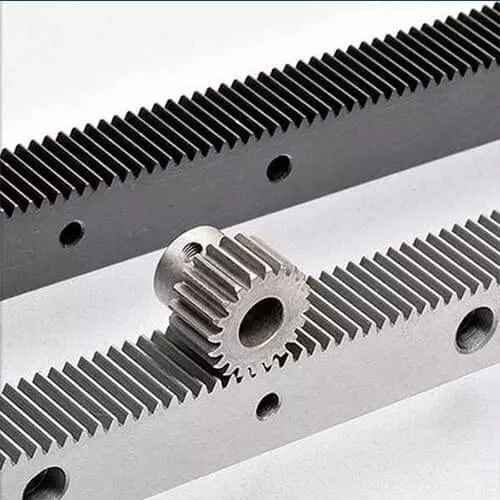
- High Precision Gear Rack
The Core Concept: Rotational to Linear Motion
At its heart, a rack and pinion system does one job perfectly: it converts rotational motion (spinning) into linear motion (moving in a straight line), or vice versa.
To understand how it works, you only need to look at its two moving parts:
The Pinion: This is a standard, circular gear. When you apply power (via a steering wheel, an electric motor, or a hand crank), the pinion spins on a fixed axis.
The Rack: This is a flat, straight bar with teeth cut into it. Instead of spinning, the rack moves back and forth in a straight line.
When the pinion spins, its teeth mesh with the teeth of the rack. As the pinion rotates, it pushes the rack along a linear path.
Step-by-Step: The Mechanics in Action
To see this system in action, let’s look at the most common place you'll find it: your car’s steering system.
The Input: You turn the steering wheel.
The Rotation: The steering shaft rotates, which directly spins the circular pinion gear at the bottom of the column.
The Mesh: The teeth of the spinning pinion lock into the teeth of the flat rack.
The Linear Shift: As the pinion spins clockwise, it forces the rack to slide to the left. If you spin it counterclockwise, the rack slides to the right.
The Output: The ends of the rack are connected to your car's wheels via tie rods. As the rack shifts left or right, it forces the wheels to pivot, turning your car.
Mechanical Advantage: The Math Behind the Motion
The rack and pinion isn't just about changing direction; it's also about control and power. Two main factors dictate how a rack and pinion system behaves:
1. Gear Ratio and Travel Distance
Unlike two circular gears, where we count teeth to find a ratio, a rack and pinion relies on the pitch circle diameter of the pinion.
If the pinion has a large diameter, turning it once will move the rack a long distance. This is "fast" but requires more effort.
If the pinion is small, turning it once moves the rack a short distance. This requires less effort but more turns of the wheel.
2. Backdrivability
A major benefit of this system is that it is usually backdrivable. This means that if you push the flat rack, it will force the circular pinion to spin. In a car, this is what causes your steering wheel to snap back to the center automatically after you complete a turn.
Where is it used?
Because the system is incredibly durable and precise, it is used across dozens of industries:
Automotive Steering: The industry standard for cars, SUVs, and trucks because it provides a tight, responsive feel to the driver.
Stairlifts & Rack Railways: When a train needs to climb a mountain that is too steep for normal tracks, a rack is placed between the rails, and a motorized pinion on the train pulls it up the incline safely without slipping.
CNC Machinery & 3D Printers: Massive automated cutting machines use rack and pinion systems to move heavy cutting heads quickly and precisely along the X and Y axes.
Why Engineers Love It (And One Limitation)
Like any mechanical component, the rack and pinion comes with distinct pros and cons:
The Advantages:
Simplicity: With only two main components, there are fewer parts to break.
Precision: It offers highly accurate feedback with very little "slop" or play in the movement.
Compact Design: It takes up very little vertical space, making it easy to pack into tight spaces like a car engine bay.
The Limitation:
Backlash: Over time, as the metal teeth wear down, a tiny gap can form between the pinion and rack teeth. This causes "backlash"—a slight delay or wiggle before the gears catch. Fortunately, modern systems use spring-loaded tensioners to minimize this wear.
The Final Output
The rack and pinion gear is a perfect example of how simple geometry can solve complex mechanical problems. By matching a circle to a straight line, engineers unlocked a dependable way to guide everything from a 2-ton SUV around a sharp corner to a heavy freight train up a mountainside.
Report this wiki page